Sunday, 19 June 2011

Some Decisions are Easy, Some Not So Much

Some decisions are so easy - I knew just where to put the Sea Buckthorn, just as I knew where to place the peach coloured rose bush our friends gave us, whose blooms, by the way, smell just like a bowl freshly picked raspberries, still warm from the sun. So why can't I decide where to put my Lemon Verbena? Each afternoon I come home from work, determined to plant it. I pick it up. I look at it. I sniff it's leaves. I carry it around the garden, and then I put it back in the "nursery", beside my other pots of little plants; mostly rescued volunteers that will also need a home soon, too.

I can now see little apples on the very top branches of my Apple/Crabapple tree. I hope I get a bite or two of some of them. The tree's branches are growing on either side of the hydro lines, and the apples are growing at the very top of the branches, so climbing and picking them is not an option. Really, no decision is necessary. I have to wait, and hope that a few apples will drop when they are still in relatively good shape, and that I'll find them before too many other hungry things do, so I can get a bite or two. I don't know what kind of apples they are, but I do know that they're yellow skinned, and the sweetest apples I've ever tasted.

I'm having a great harvest from my chamomile, pennyroyal and roses. It's a difficult decision to harvest the rose petals. If I leave the flowers on the bush, the petals wilt, fade, fall off, and become impossible to use later. If I pick them when they're bright and fresh, I can't sit and enjoy looking at the flowers on the bush. I must say that I'm not agonizing over very petal, but I am glad to say that I'm gardening consciously and deliberately. I do confess that at times it's nice to be out, just letting my mind wander, but there's also a great deal of satisfaction to be had by being present in the garden, and working mindfully, paying attention, and paying gratitude, to everything.  

I do love it when I see the garden preparing for the following year. The raspberries are simultaneously bearing fruit on last year's canes, and sending of strong, tall straight canes for next year. The Tayberry is doing the same, and if I let them, the new stalks, which are thicker then my thumb, will continue to climb upwards of eight feet. This is not convenient, as you can imagine, picking berries eight feet off the ground is no simple task, especially when I'm competing with wasps for the ripe berries. I will nip then ends off these stalks when they get to about five feet high, and I will then train the side shoots to grow on the arbor that I have build for them. Last year, the side shoots where so thick that Cardinals, who have build a nest somewhere on our property for the last 10 years, decided to build their nest nestled in the side shoots that I had secured to the arbor. Unfortunately the babies didn't survive, so I hope that the Cardinals will find a new spot for their nest this year.

My beans are growing, well, they're growing as fast as bean stalks! They'll grab on to and spiral around anything they touch. The tomatoes have finally caught on, and have become ready for support, so I've been putting the cages around them. I've decided this year to keep better control over the tomato side sprouts. Yes, yes, I know, I say that every year, and every year I get these multi-stalked, out of control tomato jungles that are difficult to approach, much less harvest. Well, I really mean it this year! Every day I have been inspecting each tomato stalk, and picking out the tiny sprouts that reappear over night, as if by magic, and the base of every leaf where it meets the stalk. Those plants never give up, no matter how many sprouts I nip from the same spot! Has anyone ever found out how to prevent this?? I for one would love to learn. The plants are now flowering, and a few even have a few tiny baby tomatoes starting to grow.

Another easy decision is to pull out all the mint I can find. One day, many, many years ago, I was thoughtless enough to plant mint in my garden bed. Although I did finally eradicate the spearmint, through thorough and frequent digging, I was not as effective with the ginger mint. Regularly during the season I dig out all the sprouts, trying to take as much root as I can. At the end of every season, I do a really good, careful dig, again trying to remove what I hope will be all the roots. So far the ginger mint continues to regrow, so I have mint to harvest all season. I can harvest wantonly, with abandon, even, all the while being quite sure that it will not be my last mint harvest. Oh well. Tea for all, I say.


Saturday, 11 June 2011

After the Rain

Last Wednesday, I was in the garden about 6:30 p.m., when suddenly it seemed as if someone had turned out the lights. It got dark in an instant, and then the wind picked up, and the sky turned that scary green colour that means "take cover, and not under a tree". A fierce storm came through, complete with hail. I was concerned for the garden, fearing the worst for my young seedlings. I was reassured to find that only a few plants were laying down, such as my Lamb's Ears:

  
and they all popped right up again.   Just to the right of the Lamb's Ears are some Lady's Mantle. The shape of their leaves allows them to hold on to water droplets, and they rest on the leaves like sparkling gems:


My trick of propping little guys up with pine cones worked very well, and helped my tomatoes and ground cherries to remain standing throughout the onslaught of wind and hail: 

 
The garlic is now thick and lush. The slender spates have grown into curls as elegant as a swan's neck. Here is one, which grew surrounded by a volunteer copse of Love In a Mist:


 As delicate and romantic as the spates appear, alas, what starts in the garden is often destined to end up on the table. I'm seeing salmon, steamed with lemon, a little freshly cracked pepper, and these spates, photographed beside their cousin, a chive patch in bloom: 


Speaking of volunteers, I continue to be surprised by what sprouts in the garden in what is most often a rather unusual place. I never plant Pennyroyal. Instead, I hunt for the volunteer patches that grow every year. This year they are growing on the path between two of my garden beds. Now I have to tread carefully along my paths, while I train the Pennyroyal to grow in the beds, instead of where I need to walk!


I have a bramble volunteer in one of the containers on my front porch. It sprouted along with the greens that I have sown in the container, hoping to outsmart whatever is eating my greens in the beds at the back of the house.


I'll have to wait until it has some berries, to know exactly what kind of bramble it is. 

I get so many evergreen volunteers, and I don't have the heart to pull them out, so I'll either let them grow in place to get a little stronger, or I'll transplant them to a pot, and hope that I'll find a good home for them. Here's a cedar and two pine trees (although I think one of the pine trees isn't looking so good):


And here's what happens when I don't find a good home for them - I continue to foster them until they are teenagers....


These are some four and five year old cedars, who need a home. If you look carefully, you can see a two year old pine tree peeking out from under the cedar on the left. We have one of these adult trees on our lot - and it's one of the largest pine trees in the neighbourhood.  I am overrun with Lilac and Ironwood seedlings, and I do, with regret pull them out. Please speak up if you would like some.


As for the rest of the garden, it is growing slowly but surely. I have managed to keep some peas safe from the slugs - whether it was the weather, the location or the coffee grounds I suppose I'll never know, but here they are, slowly climbing their trellis.


The gooseberries are looking promising, hanging like beautiful emerald drop earrings:


And the red currants are doing well also, supported this year on tomato cages.


Thankfully, the Black Raspberry continues to thrive:


And the Elderberry, Lavender and Peach Roses are ready to bloom:


As much as I love the Sweet Woodruff that's growing in the rock garden, and I did know it would spread, (that's one of the reasons I put it there), I wish I had known that it spreads faster then mint, and makes such a thick carpet that it even out-competes the Forget-Me-Not! Here's the Sweet Woodruff in my rock garden, flanked by some Hyssop, Day Lilies and Carnations. Soon it will have tiny, delicate white flowers.


I could spend whole days in the garden, making tour after tour, always finding something to do on each trip. One tour to see what needs to be done in the next hour, day and week. One tour to dream about what to do next year. There's always another sprout to celebrate, another harvest to bring in, another feeding, another weeding, another staking, another pruning. Another tendril to train, another scent to savour, a few minutes to spend taking in all the different shades of green, and a few more to spend listening to the wind in the trees.


Friday, 3 June 2011

Delicate Potential

This is such a delicate time of year. Seedlings have just been planted, or seeds are just sprouting. Both have so much potential, and both are also so terribly vulnerable. I can look at the garden in the morning, and think that things look good, plants look happy and healthy, and I can imagine the bounty to come. I can come home later that day, and if it's been very hot, the little plants might be soft and wilted. If there has been a hard rain, some of the plants might be found sideways, their first leaves stuck in the mud. At these times it's more difficult to conjure up the images of full salad bowls and long rows of preserve jars. I can finish weeding some tender seedlings in the evening, looking forward to beans and peas. In the morning I can wake to find stalks with chewed ends where so much life force was a few hours ago. Even now I am sprouting yet more bean seeds, to replace those that were lost to someone or something's meal. This time I'll wait until there are at least two, and maybe even three sets of true leaves, so if some are eaten, the plant may still survive. When the plant has only its first leaves, if they are eaten, the plant has no recourse but to waste away. There doesn't seem to be any node type area where more new leaves can sprout.

My husband was so clever, and noticed that a local supermarket had frozen Sea Buckthorn berries. He bought some for me, so I could experiment with some recipes, in preparation for future harvests and preserving marathons. My little trees are happy in their new home, doing well and settling in.

A friend has given me some large collard green plants. I'll find a place for them in a shadier part of the garden. I just learned that Bulk Barn carries grits, so I'll be able to have Collard Greens and Grits later in the summer!

Gardening is such a mix. Preparing and repairing, hoping and mourning, pulling things from the ground that I don't want, and pulling things from the ground that I do want. Planning where things will go, and planning what things must go. Anticipation and dread. Happiness and worry.

Sometimes when I'm out working in the garden, I imagine being a homesteader one hundred, two hundred, and maybe even five hundred years ago, depending on the food that will come out of the ground. I try to imagine what I might be thinking throughout the various gardening phases of the spring, summer and fall. Stakes were mighty high - survival through the winter depended on garden/farm success during the growing seasons. I try to make the effort to optimize success, in solidarity with all those past gardeners. If they hadn't succeeded, where would we be? I know how fortunate I am, that in truth, my gardening is play. I can always go to the store if I have a crop failure. Even so, I garden with my whole heart, just as I would if my life really did depend on it. 


Monday, 23 May 2011

Variable Weather

Today the weather was certainly variable, starting off clear and cool, which quickly became clear and hot, and then just as quickly became cool and rainy. Thankfully, I got up early and did all the gardening chores before the rain came. It's actually raining now, as I sit on my porch, write, and drink coffee with goat's milk. This afternoon I'll turn the rest of the goat's milk into a sweet, fresh cheese. We'll likely have the cheese spread on the last slices of rosemary-garlic bread that I baked the other day. 

The pair of Sea Buckthorn were moved into their permanent homes today. The spot went from this: Holly lying on the ground, Euonymous still there with some of its roots exposed:  

 To this: Holes, compost and occupants ready:


To this:  Two Sea Buckthorn trees, snug in their new home. Male on the right, female on the left).


I only lost one set of leaves from one bean plant last night. Who/what would have been so selective? I replenished the collar of coffee grounds. This is coffee protecting my cucumbers:

I'll have to make another run to Starbucks soon. This time I'll give them one of my buckets to fill, and I'll come back with the car!


The Flowering Crab Apple tree I have in front of the house has just broken into full bloom. I can smell it's fabulous perfume every time the breeze blows towards me from the direction of the tree. I love how the blossoms are so thick that you can't see any leaves, and can barely see any branches. The branches remind me of the flowers we used to make in first grade, when we glued little balled up bunches of coloured tissue paper to popsicle sticks, and call them Hyacinths.


What I now call my Flowering Crab Apple tree has an interesting history. The actual tree that grew there, a lovely specimen with one trunk, fell over about 10 years ago. We cut it up for firewood. Unfortunately we turned our back on the pile of wood - for less then five minutes, I swear to you - and it was gone. Soon the tree sent up some water sprouts from the roots. I kept five, and trimmed all the others back. Four of the sprouts were from what was left underground of the grafted Crab Apple tree. Its leaves have a pink tinge to them, its new branches have young, red bark, and it blooms in spectacular, little pink blossoms. As it turned out, the other sprout was from the rootstock, and has green leaves, its young bark is brown, and it has beautiful white blossoms that some years give me the sweetest yellow apples I have ever tasted! I love my chimera apple tree, just the way it is.


Forget-Me-Nots have once again filled in my rock garden. What a nonsensical name for a flower that you can't possibly forget, since it behaves with with such fecundity, reseeding itself, and spreading further afield, year by year.


I harvested a bit of Sweet Cecily this morning, too. It has already started to flower! I just took the leaves that were overhanging their raised bed, and starting to get in the sway. 
I don't mind brushing by their soft, feathery leaves, but I'm not the only one to use the walkway, so a trimming job it was.


A big chore around here is pulling out the Garlic Mustard before it sets seed. Its an invasive plant here in Ontario, and often it seems like a loosing battle to keep it off my property, especially when I see the wild edges of the public parks thick with it, but I keep yanking them out, any time I see one. They seem to have a preponderance for growing where it is "dangerous" to pull them out, such as right beside my rose branches, or inside my bramble patch. Yeow.


I'm looking forward to a good garden season. Now I'm off to pick some asparagus for lunch. A omelet, perhaps. Maybe I'll make that goat cheese first...

Sunday, 22 May 2011

Garden In, Garden Out.

Yesterday was the first really hot day, so of course it was time to put in the peppers. Twelve pepper plants - four red, four orange and four little hot pepper plants. A dozen of my ground cherry sprouts found their garden spots, too. New rows of beets, chard, and spinach went in, and I sowed a few plots of pennyroyal since I love the smell, and I use it to make my closet sachets. I like to grow the pennyroyal away from the edibles, but where I can still enjoy it, so I use it like ground cover in my large planters. I love how it spills over the sides as it grows.

As I planted, my husband was on the roof, cleaning out the clogged eaves troughs. We have the largest pine tree in the neighbourhood, and it is a copious producer of needles. I use them as mulch on my raspberries and garden paths, and even so, there's lots left over to fill many garden waste bags Oh - and to clog our eaves troughs. So he's up there, tied off with a rope, filling many garbage bags with guck. Thank goodness, because that's something I couldn't do.

I dropped into Starbucks on my way home from work on Friday, and carried home about 20 lbs of used coffee grounds. (They were still warm!) It was a little like carrying a heavy, squirmy baby. I read on a gardening website that coffee grounds were good for repelling slugs, and heaven knows I have a slug problem. Last year the slugs ate my bean sprouts the second they broke the surface of the ground. So I thought - OK, what if I sprout them inside, and plant them when they're a bit older and stronger? Hmm. Same thing, only this time I was witness to the sad, chewed of stems. So...this year - I sprouted a dozen "hills" inside, and as soon as they surfaced - which I'm always amazed to see only take a few days - I put them in the ground outside, and surrounded them with a moat of coffee grounds. It's been two nights, and so far all have survived. I am hopeful! I also replanted peas, and covered the planted ground with a blanket of coffee grounds. That will be a true test, as the slugs have been diligent at finding the pea sprouts.

It's become important to get my new Sea Buckthorn trees in the ground, and the Holly and the Euonymous had to go, to make room for them. This morning I was out there with shovel, clippers, rake, saw, and trowel, and after about 2 hours I had wrestled the Holly out of the ground. I did save a dozen clippings, and they're in a jar with water and willow sprouts as I write. I apologize to the worm god. Many gave their lives this morning in the carnage. I tried to be careful, but it is hard to know what's going on underground when you put in the shovel.

Wednesday, 18 May 2011

The First Harvests

It's been such a cold, wet spring, that there hasn't been a lot to harvest yet. I'm keeping my harvest spreadsheet  here. 

My first harvest was Mache, or Cornsalad. I planted some a few years back, when I became an Eliot Coleman disciple. It reseeds itself freely, and comes back year after year. I eat as much as I want, and let the rest flower and go to seed. Presto - more spring salad the following year.

Today I harvested rhubarb, and made a lovely rhubarb sauce and served it hot over plain yogurt. I spooned the yogurt into bowls, and then put the bowls in the freezer until dessert time. Here's the recipe, enough for dessert for two:

325 gr freshly harvested rhubarb, washed and cut into 1/2 inch slices
1 tbsp brown sugar 
2 tbsp dried currants (because my husband doesn't like raisins. I'd rather use raisins, but the currants are good too)
1/4 tsp grated orange rind
1 orange cut into supremes
A few dried prunes

Place the rhubarb, sugar, currants, prunes, orange rind, and 2 or 3 of the supremes into a saucepot on medium heat, and bring to a simmer.
Continue to simmer, stirring occasionally until the rhubarb is soft.
Taste and add more sugar if you wish. Add water 1 tsp at a time if you would like the sauce thinner. Add a mixture of 1 tsp cornstarch and 1 tbsp water if you want the sauce thicker. Boil the cornstarch mixture in the sauce for 2 minutes to cook the cornstarch.
You may prepare the sauce up to this point, and let it sit, covered, until after dinner. Heat it back up briefly just before serving.
Divide the sauce evenly over bowls of frozen yogurt, and garnish with the remaining orange supremes.

- - - - 

I am very, very happy to announce that my black raspberry has actually shown signs of life. I approached it yesterday to begin the sad process of removing the dead canes from the garden. I was snapping the brittle, brown canes off at ground level, when something caught my eye. From the very base of one of the canes, I discovered two shoots, sporting their deep red color that will turn green as they mature. So exciting. 

I'm keeping watch on my indoor seedlings. I had given up on the Datura seeds, and planted more Ground Cherries in the same little peat pots. However, now I'm noticing shoots that are definitely not Ground Cherries. Could it be a few Datura that have finally germinated??  I'll know when the true leaves come out.

I'm also having trouble with slugs. It's been so wet. I'm going to try coffee grounds, and coffee spray. I'm also going to remove all the mulch I have on my garden beds. It's soggy, and it's making a much to comfortable home for them. I'll have to rake it all up and dispose of it.

There's a large Ivy intertwined with a large Euonymous that is in the perfect spot for the new Sea Buckthorn trees, so I'm in the process of removing them. They are originals - they were they when we moved in, in 1992. It's a big decision, to remove something that well established, but it's going to open up the yard nicely. I'm going to try to root some of the Ivy. I'd like to plant some at the front of the house, where some shrubbery is badly needed. I'll put some new growth Ivy cuttings, along with some Willow cuttings into some water. The Willow has chemicals that act like rooting hormone, and will help the Ivy cuttings make roots.

Now I'm off to the books. The rhubarb is doing so well that I want to look up my rhubarb preserve recipes. I want to start selecting this year's flavours, and I'll be starting with rhubarb!

Friday, 13 May 2011

Well, Something's Lost but Something's Gained in Living Every Day

I just love this time of year, when things first start to poke out of the ground. I get to see what has survived the winter, and I go on treasure hunts, looking for plants that have seeded, spread or otherwise popped up in an unexpected place.  

One summer I enjoyed a Datura that thrived on the periphery of one of my garden beds. I hadn’t had a Datura growing for at least 5 years. It must have grown from a seed that had remained viable in the ground for that long, its will to live and its drive to survive stronger then time itself. 
This year I am delighting in the downy soft new growth of catnip,


and I’m happily watching gooseberry volunteers sprouting their thorny selves beside their mother. Last year I worried that I was going to become overtaken by my Lemon Balm, so in the fall I ripped out all my plants, roots and all. I tried to worry that I would have to buy new plants this year, but I just couldn’t muster up a good level of anxiety. Why? Because just as I was pretty sure they would, a few patches of Lemon Balm have already made their presence lustily known, their slightly pebbly new growth gleaming with a deep, luscious green glow. 

Ah, but the losses. My beloved Black Raspberry did not survive. I didn’t think it was such a terrible winter, so I just can’t understand why it died! It was positively luxuriant last year, and sent up very healthy new growth, which I dutifully trained on its arbor all summer and fall.  I had discovered this bramble in the deep shade between my house and the house of my neighbour to the west. It was tiny and twisted, and gave only a few precious berries every year. A few years ago (and I sometimes wonder why it took me so long) I had the brilliant idea to take the tiny, struggling twig of a cane, and transplant it to a proper garden bed where it could enjoy proper sun, water, care and trellising. Well, this plant rewarded me with the most exuberant explosion of growth that you could imagine. It went from producing six berries to 6 cups of berries, and did better every summer. Until, I am now sadly realizing this summer. Now I am combing my property, looking for just one, tiny, thorny volunteer – perhaps from a seed dropped by bird, a squirrel, or even by me. Something thorny is growing in my gooseberry bed. It’s definitely not a gooseberry, I can tell because of the leaves. I have just sold my last jar of Black Raspberry jam, so I’m hoping against hope that what I am watching is a new black raspberry plant reaching towards the light from under my gooseberry bush. 

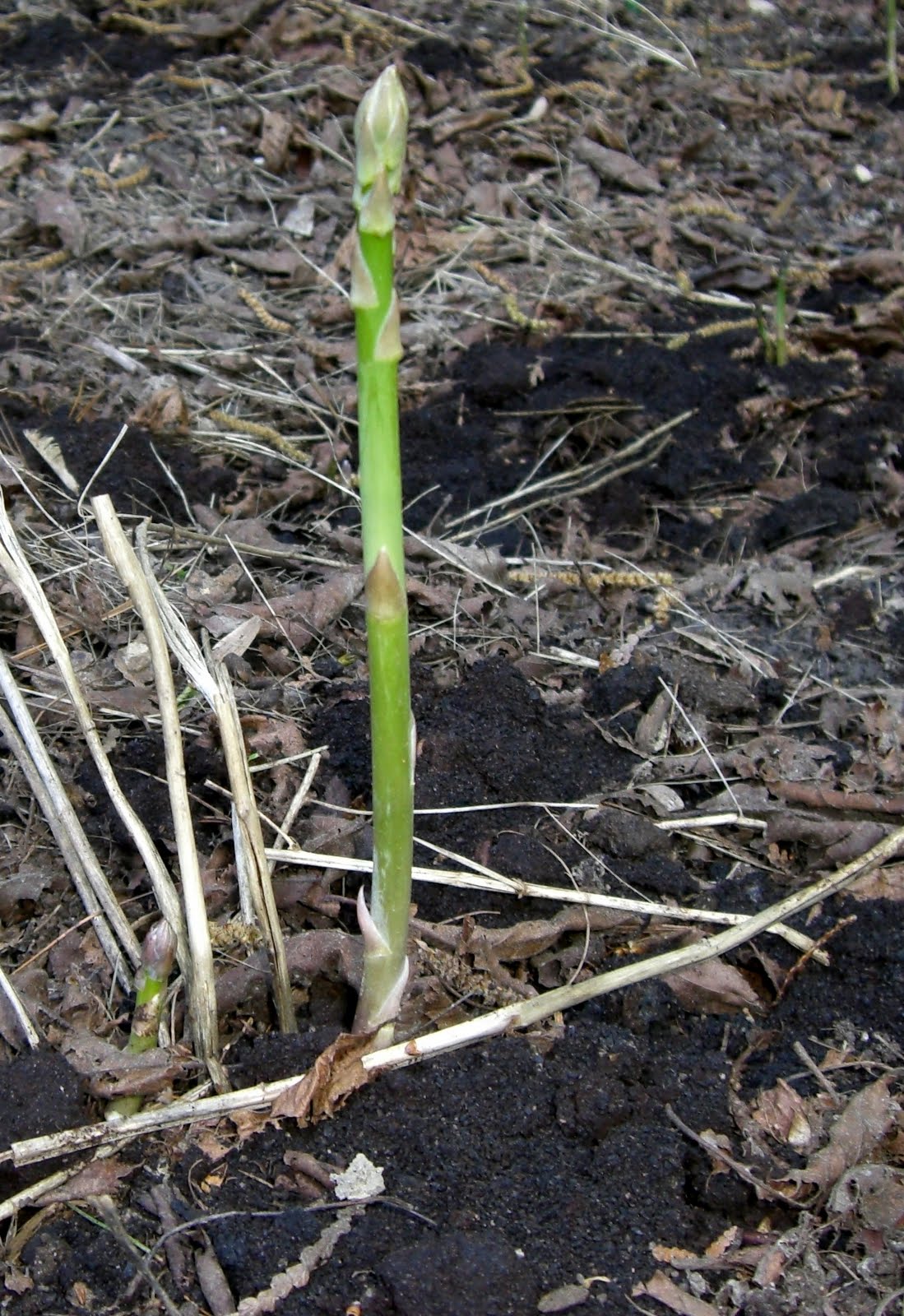
Speaking about reaching towards the light, I have been crouching daily beside my asparagus bed, delicately scraping away the layers of winter mulch to see if I could detect any indications of growth. Today I discovered asparagus, starting to break the ground! All different sizes and colors  – some thinner, some thicker, some still stark white, some beginning to darken to green, and some even having what seems to be a bit of a purplish cast.  


Something has been nibbling on my pea sprouts, and I’m wondering if I need to protect my asparagus. What should I do? I’ll have to go back to my shelf of garden books. I’m sure Rodale has some advice for me. But nothing ever ate my pea sprouts before! How am I to grow peas if the sprouts keep being eaten to the ground??

It’s now past the last frost date for Toronto, and warm enough at night now, I think, to plant the tomato seedlings. I have grape cluster tomatoes, cherry tomatoes, and some midsize tomatoes. I am staying with smaller tomatoes this year, as I have better luck with them. At the end of the season, I always have so many large green tomatoes. I figured if I stay with smaller ones, they would have a better chance of ripening before the season ended. This year, if I have green tomatoes, I’m going to try a technique I read about. Before the first hard frost, the technique requires that you pull the whole plant out of the ground, and hang it upside down in a cool dark place, such as a cold cellar or garage. Word is that the green tomatoes will ripen. I’m slightly skeptical, but, after picking a few green tomatoes for slicing, breading, and frying, I will have nothing to lose.

So far I have planted 10 tomato seedlings, using lots and lots of my homemade compost. I have also put my home-rotted compost around my raspberry sprouts, on my asparagus bed, and around all my garlic sprouts and new herb patches. I sure hope it’s good compost, or my garden is in big trouble! I’ve spread four large buckets of it, and I have at least eight buckets left. Perhaps more.  After I planted the tomato seedlings up to their necks in holes back-filled with compost, I then take a handful of the huge pine needles I have laying under my trees, and build a little nest on the ground around the base of the plant. I snuggle the needles up against the plant, to help support the leaves. 


I like to think it gives them a bit of protection during their first few days and nights – especially from wind, which they have had only little opportunity to experience. My seedlings were bought from a nursery that stores them outside, so I figured they were already hardened off to some degree, but as I always say, a little support can never go amiss. 

I plan to go big in the lavender department this year, so I augmented my two lavender beds with some new seedlings. My lavender has been spreading, but rather slowly, so I supplemented it’s journey down the side of my driveway. Last year was such an awesome year for the garden, with such a warm, early spring, hot summer, and warm fall. I had three flushes of blooms on my lavender, and on my roses! I will continue to deadhead earnestly, of course, and also send messages of love, support and gratefulness to Gaia, hoping to foster in her warm and generous sentiments which she will translate into a special growing season.

My garden addition this year that I am most excited about is two Sea Buckthorn plants – two two-year-old trees, to be specific. Not only are Sea Buckthorn saplings difficult to find, but trying to source quality plants is even more of a challenge. I found one farm in Ontario that sells beautiful plants, and I am now the proud owner of a “family,” one female tree, and one male tree. Can I really use the word "owner" if I'm referring to new family members?  I have beautiful visions of jars and jars of jam, jelly, and juice. I know I’ll likely only get a handful of berries this year, if any, but I am promised that the trees should be as tall as me in two years, if grown under optimal conditions. I have also been counseled to keep them pruned at about that height, and not let them get taller. Likely because they will become unmanageable. I will definitely keep posting on their progress.  

I have another goal this year, to do something I have not done before, which is to weigh all the produce that comes in from the garden, and keep a record of the weight, and what I did with it, such as eat it, freeze it, dehydrate it (i.e. fruit or vegetables) for future consumption, or dry it (i.e. herbs and flowers) for the production of Arethusa’s edibles and skin care products.
Once again, raccoons have made their presence known in my garden. There is a nicely protected corridor between the last row of berries and my deck. Year after year, the raccoons adopt this spot, to put it bluntly, as their toilet. Each year I try a new way to discourage them.  The “scarecrow” which has a motion detector, and which will send jets of spray at anything that moves within its range of detection, does work well, but if I forget to turn off the water before I go weeding or berry picking, I get quite the hard spray. Sometimes, if I’m lazy, I’ll try to sneak around the scarecrow, but more often then not, I grossly overestimate my skill of being able to sneak about my own garden undetected, and return to the house abashed, and dripping. This year I’m taking a two pronged attack. One, the scarecrow.  Two, I have acquired a large amount of rosebush clippings, and I have constructed a deep pile of them where the raccoons like to go the most.  So far, no “fresh” signs of raccoon visits. May it continue to be so.